Blog

  • How to Prepare for UCEED, NID DAT & NIFT Entrance Exams Together: Complete 2026 Strategy

    How to Prepare for UCEED, NID DAT & NIFT Entrance Exams Together: Complete 2026 Strategy

    The blog gives you a proper strategy for all 3 exams. How to Prepare for UCEED, NID DAT & NIFT Entrance Exams Together in 2026

    Apply Now

    Introduction

    Most students preparing for design entrance exams make the same mistake: they treat UCEED, NID DAT, and NIFT as three entirely separate exams and build three separate study plans. This leads to exhaustion, confusion, and often, weak preparation on all three.

    The truth is that these exams share far more in common than most guides acknowledge. All three test your ability to observe the world carefully, think visually, reason logically, and communicate ideas through drawing. A student who genuinely develops these skills is not preparing for one exam. They are building the foundation that every design school in India is actually looking for.

    This guide gives you a single, integrated preparation strategy for all three exams. You will find a clear picture of each exam’s structure, a table showing exactly where the syllabi overlap, a 180-day and 90-day study roadmap, specific drawing practice methods, exam-specific tips, and a mock test framework, all in one place.

    Whether you are appearing for one, two, or all three, this strategy works because it is built around the skills that matter across the board, not around memorising separate syllabus lists.

    Understand UCEED, NID DAT & NIFT

    Before building a combined plan, understand what each exam is actually testing and where the programmes lead.

    UCEED (Undergraduate Common Entrance Examination for Design) 

    Conducted by IIT Bombay, UCEED is the gateway to B.Des programmes at IIT Bombay, IIT Delhi, IIT Guwahati, IIT Hyderabad, IIT Indore, IIT Roorkee, and IIITDM Jabalpur. The exam tests visualisation, spatial reasoning, observation, logical reasoning, creativity, design awareness, and drawing. It is one of the most competitive design entrance exams in India. 

    NID DAT (Design Aptitude Test) 

    Conducted by the National Institute of Design (NID), the DAT is the entrance test for B.Des and M.Des programmes across NID Ahmedabad, NID Bengaluru, NID Gandhinagar, and other NID campuses. The exam has two stages: DAT Prelims (a national screening test) and DAT Mains (a studio-based test and in-person sensitivity test held on campus). From 2026, the Prelims score carries no weightage in the final merit. It is used only for shortlisting.

    NIFT Entrance Examination

    Conducted by NTA for the National Institute of Fashion Technology, this exam covers B.Des and related programmes across 16 campuses in India. For B.Des candidates, it has two components: the Creative Ability Test (CAT), which tests drawing, creativity, and design thinking; and the General Ability Test (GAT), which tests reasoning, English, quantitative ability, and general knowledge. Shortlisted candidates then appear for a hands-on Situation Test.

    UCEEDNID DATNIFT
    Conducted byIIT BombayNID AhmedabadNTA / NIFT
    ProgrammesB.Des at IITsB.Des and M.Des at NIDsB.Des and M.Des at NIFT campuses
    Number of Stages1 exam (Part A + Part B)2 stages (Prelims + Mains)2 stages (CAT+GAT → Situation Test)
    Drawing ComponentPart B (100 marks)Mains: Studio TestCAT (100 marks, 50% weightage)
    Aptitude ComponentPart A (200 marks)Prelims screeningGAT (30% weightage)
    Unique ComponentNegative marking in MCQ sectionIn-person Sensitivity Test (40% of Mains)Situation Test (material handling)

    Syllabus for UCEED, NID DAT & NIFT

    This is the single most important section for building an efficient combined preparation strategy. A large proportion of what these exams test is the same, which means focused practice on shared topics multiplies your preparation value across all three.

    Overlapping Topics (prepare once, benefit in all three):

    • Observation and Attention to Detail: All three exams test whether you notice things others miss. UCEED’s NAT section tests precise visual observation; NID DAT Prelims and Mains rely heavily on observation-based design prompts; NIFT’s CAT rewards candidates who translate observations into creative compositions.
    • Visualisation and Spatial Reasoning: UCEED Part A directly tests spatial reasoning and 3D visualisation. NID DAT tests your ability to visualise forms and represent them in 2D and 3D. NIFT’s Situation Test asks you to construct 3D models.
    • Analytical and Logical Thinking: UCEED Part A includes logical reasoning and analytical ability. NIFT’s GAT has an analytical ability section. NID DAT Prelims (before the 2026 removal of GAT) tested design-linked reasoning.
    • Design Awareness and Sensitivity: Knowledge of product design, graphic design, Indian crafts, design history, architecture, and everyday design is tested across all three.
    • Drawing: Composition, Proportion, Perspective: UCEED Part B tests drawing skills in 1 hour. NID DAT Mains is almost entirely drawing and making. NIFT’s CAT is a 3-hour drawing-based exam. Practice here benefits all three simultaneously.
    • Creativity and Idea Generation: All three reward novel, original thinking in response to a brief, not safe or predictable answers.

    Exam-Specific Topics (targeted preparation needed):

    TopicUCEED OnlyNID DAT OnlyNIFT Only
    Reading comprehension✓
    Numerical / data interpretation✓
    Multiple-choice reasoning (with negative marking)✓
    Studio Sensitivity Test (hands-on with materials)✓
    In-Person Sensitivity Interview✓
    Quantitative ability and GK for GAT✓
    Material handling and 3D model making✓
    Current affairs and fashion awareness✓

    The overlap is substantial. Roughly 60–70% of what you need to master is shared across all three exams. This is the basis of a combined strategy.

    Build a Combined Study Plan for Bachelors of Design Entrance Exams

    180-Day Roadmap (6 months before exams)

    Months 1–2 (Foundation Phase): Focus entirely on building the core skills that all three exams share. Do not touch exam-specific topics yet.

    • Daily: 30–45 minutes of observational drawing from life (objects, people, spaces)
    • 3 days a week: Aptitude practice covering visual puzzles, spatial reasoning, pattern recognition
    • Weekly: One visit to a market, museum, exhibition, or design-rich public space with a sketchbook
    • Goal: Build the habit of seeing carefully and drawing consistently

    Months 3–4 (Skill Development Phase): Introduce exam-specific skills while continuing foundation work.

    • Drawing: Add perspective drawing, human figures, product sketching, storyboarding
    • Aptitude: Introduce NID-format design awareness questions, NIFT GAT sections (quantitative, GK, English), UCEED Part A NAT and MCQ practice
    • Begin first mock tests: One per exam per month, untimed at first
    • Portfolio: Start collecting your best 3–5 sketches weekly

    Months 5–6 (Refinement and Mock Phase): Simulate real exam conditions and identify gaps.

    • Drawing: Timed practice only. UCEED Part B: 60 minutes. NIFT CAT: 3 hours. NID Mains: extended studio sessions
    • Aptitude: Full Part A mocks at least once a week
    • Revision: Weekly review of your previous month’s mock errors
    • NID-specific: Practice material handling for Situation Test awareness; research previous NID Studio Test prompts
    • NIFT-specific: Intensive GAT practice, especially GK and analytical reasoning

    90-Day Roadmap (for students starting late)

    If you have 3 months, compress the plan aggressively:

    • Weeks 1–3: Foundation drawing daily (no exceptions) + basic aptitude mapping
    • Weeks 4–7: All exam-specific topic practice in parallel + 1 timed mock per week per exam
    • Weeks 8–10: Full-length mock tests twice a week + error analysis every session
    • Weeks 11–12: Revision only. No new topics. Target weak areas identified from mocks.

    Weekly Timetable (Mid-Preparation Phase)

    DayActivityTime
    MondayObservational drawing + UCEED Part A practice (NAT/MSQ)2 hours
    TuesdayPerspective and product sketching + NID design awareness reading2 hours
    WednesdayNIFT GAT practice (Quantitative + English) + storyboarding2 hours
    ThursdayTimed full drawing exercise (60–90 min) + mock analysis2 hours
    FridayDesign awareness study: Indian design, craft traditions, typography basics1.5 hours
    SaturdayFull mock test (rotate: UCEED, NID, NIFT week by week)3–4 hours
    SundayError review + sketchbook work + visit museum/exhibition/local market2 hours

    Master the Common Aptitude Topics

    These five skills form the aptitude backbone of all three exams. Improving them consistently is the highest-return investment in your preparation.

    Observation: Train yourself to notice what most people walk past. The number of windows on a building, the curvature of a chair leg, the spacing of text on a signboard. UCEED tests precise observation in questions where you identify differences, count elements, or describe spatial relationships. Practise by picking one object every day and writing down or sketching five things you had not noticed before.

    Logical Reasoning: UCEED Part A includes reasoning questions with negative marking, and approaching them incorrectly costs you marks. Practice sequence identification, analogy-based reasoning, and visual pattern completion. The key skill here is not speed but accuracy: do not guess on MCQ questions unless you can eliminate two options with confidence.

    Visualisation: This is the ability to see objects from different angles in your mind. UCEED directly tests this through 3D rotation and orthographic projection questions. Practice with physical objects. Hold a pen, a mug, a phone, and sketch its top, front, and side views. This also directly improves your drawing in NIFT’s CAT and NID’s Mains.

    Design Awareness: Know the world of design beyond the classroom. Who are India’s major product designers, graphic designers, and architects? What are classic design objects such as Eames chairs, London Underground maps, Indian handloom patterns, Bauhaus typography? Follow design news, visit local crafts markets, pay attention to packaging and signage. This feeds UCEED’s design sensitivity questions and NIFT’s GK section.

    Analytical Thinking: All three exams reward the ability to break a problem into components and respond systematically, not impulsively. In a drawing question, ask: What is the brief actually asking? What constraints exist? What makes an unexpected but coherent response? This structured creative thinking is what differentiates a 70-mark drawing from a 90-mark drawing.

    Improve Drawing & Creative Skills

    Drawing is where the competition is actually won or lost. UCEED gives it 100 out of 300 marks. NIFT’s CAT carries 50% of your total weightage. NID DAT Mains is almost entirely drawing and making. Yet most students underinvest here, treating aptitude as the “real” preparation.

    Perspective Drawing: If you cannot draw a room, a street, or a product in a convincing perspective, your UCEED Part B and NID Mains drawings will look flat and unconvincing. Practice one-point perspective (a corridor, a room) and two-point perspective (a building corner, a box) every day for the first 30 days until it becomes second nature.

    Human Figures: Human figures appear constantly in design exam prompts, including people using products, crowds, narratives. You do not need fashion-illustration-level figures. You need proportionate, confident stick-figure-to-basic-body figures that communicate action and scale. Practise gesture drawing (2-minute sketches of a person in action) using reference photographs daily.

    Storyboarding: NID and NIFT often use scenario-based questions where you need to illustrate a sequence of events or demonstrate how a product is used across different moments. Practise telling a visual story in 4–6 panels with minimal text. Keep compositions clear, transitions logical, and characters consistent.

    Product Sketching: UCEED Part B frequently asks you to sketch a product: a tool, an appliance, a piece of furniture. Practise drawing common products (a chair, a kettle, a bicycle, a bag) with accurate proportions, material texture indication (metal vs. fabric vs. plastic), and basic shadow rendering to convey 3D form.

    Speed Sketching: All three exams have time constraints. In NIFT CAT, you have 3 hours for multiple drawing tasks. In UCEED Part B, you have 60 minutes for two questions. Speed without quality is useless, but quality without speed is also a problem. Practise completing a full drawing, from blank page to finished composition, within 20–30 minutes.

    Daily Creative Exercises:

    • Sketch one object from your immediate environment, from three angles
    • Complete a 10-minute visual prompt: “Design an object that solves this problem”
    • Study one well-designed object (product, poster, building) and write three sentences on what makes it work
    • Take a word and generate five thumbnail compositions around it, with no refining, just producing

    Exam-Specific Preparation Tips

    Once the shared foundation is strong, layer in these exam-specific tactics.

    UCEED Strategy: Part A is where shortlisting happens. Only candidates above the Part A cutoff get their Part B evaluated. The cutoff is calculated using the mean and standard deviation of all candidates’ Part A scores, so you need to score comfortably above the average. Prioritise the NAT section (no negative marking, 14 questions at 4 marks each = 56 marks if fully correct) and approach MSQ questions carefully (partial credit is available). On MCQ questions with negative marking (-0.71 per wrong answer), only attempt those you are 80%+ confident about. Part B: Practise both questions in exactly 60 minutes regularly. Timing discipline in Part B is as important as drawing quality.

    NID DAT Strategy: The 2026 pattern is significantly different from previous years. The Prelims score no longer contributes to your final merit. It is only a filter. This means you need to cross the shortlisting threshold at Prelims (candidates are shortlisted at 1.5x the number of available seats per category) and then perform exceptionally in Mains, where the Studio Test carries 60% and the In-Person Sensitivity Test carries 40% weightage. The Studio Test evaluates your design thinking, material handling, and creative problem-solving in a live environment over several hours. Practise extended creative sessions of 2–3 hours of sustained design work without breaks to build the endurance and focus the Mains requires. The In-Person Sensitivity Test assesses design sensibility, aesthetic awareness, and communication. Be ready to discuss your work, your influences, and your observations about design naturally and confidently.

    NIFT Strategy: For B.Des candidates, the final merit split is: CAT 50% + GAT 30% + Situation Test 20%. Do not neglect the GAT. 30% is too significant to ignore. In the GAT, there is negative marking (25% per wrong answer), so selective accuracy matters. The English and Communication section (40 questions) and the Analytical Ability section (15 questions) offer the best return for preparation time. For CAT, there is no negative marking, so attempt everything. The Situation Test is hands-on material making using items like cardboard, wire, clay, thermocol, and fabric. Practise model-making at home: set a theme, give yourself 30 minutes, and build something with whatever materials are nearby. Speed, creativity, and neatness of execution all matter.

    Mock Tests & Revision Strategy

    When to begin mocks: Start simple topic-wise mocks in Month 2. Introduce full-length mocks in Month 3. By Month 5 and 6, every week should have at least one full mock for each exam you are targeting.

    Frequency: In the final 2 months, aim for 2–3 full mocks per week across all three exams, rotating them. Avoid doing all three in one weekend. Spread them out to simulate the pressure without burning out.

    Error analysis (the most underused habit): After every mock, for every wrong or incomplete answer, write one sentence explaining why: misread the question, ran out of time, did not know the concept, or careless error. Tracking your error patterns across 4–6 mocks reveals your real weak areas faster than any study guide.

    Revision cycles: Use a 3-week cycle: 2 weeks of new practice, then 1 week of revision. In the revision week, revisit your sketchbook (are drawings improving?), your mock error log (are the same mistakes repeating?), and your design awareness gaps.

    Do not re-do mocks you have already seen. Use only fresh question sets or official past papers for timed practice. Past NID, NIFT, and UCEED papers are available free on the official websites: UCEED, NID, NIFT and are the best practice resources available.

    Common Preparation Mistakes

    Ignoring drawing until the last month. Drawing improves only with daily, sustained practice, not with a 3-week crash before the exam. Students who start drawing seriously from Day 1 of their preparation consistently outperform those who treat it as an afterthought.

    Memorising design terms instead of developing design sensitivity. Knowing what “kerning” or “affordance” means is less valuable than being able to spot good and bad kerning in the world around you, or instinctively identify whether an object’s design makes its function obvious. Understanding beats memorisation in every question type.

    Skipping mock tests. Many students do full study plans but never simulate exam pressure. The first time you sit in a real exam environment should not actually be the real exam. Timed conditions, the anxiety of blank pages, and the decision of where to spend your remaining 8 minutes. These are skills practised only through mocks.

    Preparing for one exam at the expense of the others. If you are appearing for all three, never spend an entire week on UCEED aptitude at the cost of your drawing practice. The shared skills keep all three scores rising together. Neglect one and they all slip.

    Preparation Resources for Design Students in India

    Good preparation does not only happen at a desk. The best design entrance preparation is also a process of genuinely becoming more design-aware, and that requires engagement with the world beyond study materials.

    Design events and exhibitions: India Design Week, Design Yatra, DesignUp (India’s most prominent design and technology conference), and regional craft exhibitions are all spaces where design culture is live and accessible. Attending even one such event sharpens your sense of what design actually looks, feels, and functions like. When a second-year Rishihood University student reached the Top 5 Finalists at DesignUp 2025 against 730+ global designers, it was this kind of sustained cultural engagement, not just exam preparation, that made the difference.

    Museums and cultural spaces: The National Museum New Delhi, Crafts Museum Delhi, National Crafts & Textiles Museum (Pragati Maidan), and local state museums all offer free or low-cost design education through objects. Look at how things are made, what materials are used, and how form changes across different periods and cultures.

    Sketchbooks as primary resources: No book, course, or YouTube video replaces a daily sketchbook practice. Your sketchbook is your most important preparation resource because it is the only one that grows with you.

    Online resources: The official UCEED past papers, NID DAT admission handbook, and NIFT exam notifications are all free and authoritative. Design blogs, architecture photography, product design portfolios on Behance, and typography foundries are all valid visual research.

    Design thinking beyond the exam: The skills you are building, including observation, empathy, visual problem-solving, and creative communication, are the same skills valued in every strong design programme in India, whether you enter through a national entrance exam or through a portfolio and aptitude-based admission. Programmes like Rishihood University’s B.Des evaluate design thinking and creative potential directly, making the skills you build for these exams directly relevant to a wider range of admissions pathways than most students realise.

    Frequently Asked Questions

    Can I prepare for UCEED, NID DAT and NIFT together?

    Yes, and this is the recommended approach for most students. The core skills (observation, drawing, visual reasoning, design awareness) overlap significantly across all three. A unified preparation plan is more efficient and less exhausting than three separate plans running in parallel.

    How many months should I prepare?

    Six months is the recommended minimum for a well-rounded preparation across all three exams. Students starting with strong drawing skills or prior design exposure can work effectively in 4 months. Three months is possible but requires a highly focused, daily-practice approach with no gaps.

    Which exam is the most difficult?

    All three are competitive, but they test different strengths. UCEED Part A is the most analytical and requires precision under negative-marking pressure. NID DAT Mains is the most open-ended and relies most heavily on live design performance and creative sensibility. NIFT requires the widest range of preparation (CAT creativity + GAT reasoning + Situation Test hands-on making). Difficulty is subjective. Choose based on your strengths and which institutions you most want to attend.

    Do I need coaching?

    Coaching is not mandatory, and it is not required to clear these exams. It is useful if you have no drawing background and need structured instruction to build the skill from scratch, or if you struggle to self-discipline a study schedule. What matters most is daily, consistent practice. Coaching accelerates this for some students, but it cannot replace it.

    How important is drawing practice in UCEED or NID?

    It is the single most important variable in your preparation. Drawing counts for 33% of UCEED’s total marks (100/300), 50% of NIFT’s final score (CAT), and is the primary evaluation criterion in NID DAT Mains. Even one hour of daily drawing practice, sustained over 5–6 months, produces measurable improvement for most students.

    Take the Next Step

    The preparation you are building for UCEED, NID DAT, and NIFT, covering drawing, observation, creative problem-solving, and design awareness. This is not just exam preparation. It is the foundation of a design education and design career.

    Whether you secure a seat in an IIT, NID, or NIFT, or choose a programme that evaluates design potential through a different pathway, the skills you build in this process are directly transferable. Rishihood University’s B.Des programme, for example, offers specialisations in Communication Design, UX & Interaction Design, and Product Design, with studio-based learning, industry mentors, and 6 months of paid work experience, and it admits students based on design thinking and creative potential.

    Explore the B.Des programme brochure to understand the curriculum and admission pathway, or connect with the admissions team to discuss your profile and options. If you are working toward a career in design, the right programme, wherever you end up, is one that takes your creative potential as seriously as you do.
  • B.Des Abroad vs B.Des Course in India: Which Offers Better Career Opportunities?

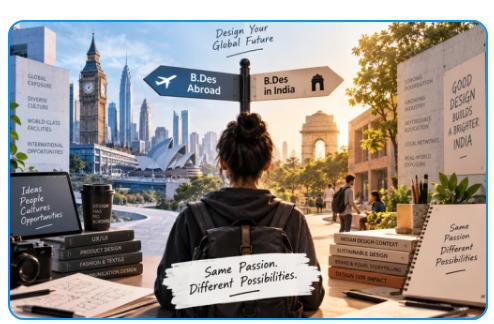
    B.Des Abroad vs B.Des Course in India: Which Offers Better Career Opportunities?

    B.Des in India offers better return on investment for most students. A B.Des abroad offers specific advantages for those pursuing careers in countries where they study, or in global design studios that require an international degree

    IntroductionThe short answer: a B.Des in India offers better return on investment for most students. A B.Des abroad offers specific advantages for those pursuing careers in countries where they study, or in global design studios that require an international degree. For the majority of Indian students, the right B.Des course in India delivers comparable design education quality, significantly lower financial risk, and increasingly strong connections to both domestic and global industry.

    That said, this decision deserves a careful comparison rather than a blanket recommendation. Career outcomes depend on curriculum quality, internship access, portfolio strength, the industry you want to work in, and the country where you plan to build your career. Cost alone should not determine the choice, but it is a factor too significant to ignore.

    This guide compares both pathways across eight criteria: curriculum, cost, scholarships, ROI, internships, career opportunities, salaries, and long-term global mobility. At the end, there is a decision matrix to help you choose the path that matches your specific goals.

    B.Des in India vs Abroad: Quick Comparison

    FactorB.Des in IndiaB.Des Abroad
    Programme Duration4 years (standard)3-4 years (UK is typically 3)
    Annual TuitionINR 2.5-10 lakh (government); INR 4-15 lakh (private)USD 25,000-65,000 (USA); £10,000-25,000 (UK); AUD 20,000-40,000 (Australia)
    Total 4-Year Cost (incl. living)INR 15-50 lakhINR 1-3 crore (USD/GBP/AUD equivalent)
    Teaching ApproachStudio-based; increasingly industry-integratedStudio-based; multicultural cohorts
    Industry ExposureStartup ecosystem, manufacturing, NCR/Bengaluru tech beltLocal industry in host country; broader design culture access
    Internship AccessStrong in metro cities; structured in good programmesDependent on country and visa rules
    Post-Study Work RightsN/A (home country)USA OPT (up to 3 years), UK Graduate Route (2 years), Australia Post-Study Visa (up to 4 years)
    Language of InstructionEnglishEnglish (USA, UK, Australia); varies in Europe
    Career in India after graduationStrong and directPossible but takes more re-integration effort
    Career Abroad after graduationRequires remote or relocation strategyDirect if staying in study country

    The table shows that the financial gap is enormous, but the career outcome gap is narrowing. Remote work and global hiring have meaningfully shifted how much geography matters when building a design career.

    Curriculum and Learning Experience

    Both Indian and international B.Des programmes follow a studio-based pedagogy at their best. Students learn by making, presenting, receiving critique, and revising. Design thinking, user research, prototyping, and visual communication are taught across the curriculum in both settings.

    Where international programmes tend to differ: The primary advantage of studying abroad is cultural diversity. Working alongside students from 30+ countries on design problems gives graduates a broader reference framework and exposure to different user contexts. Leading international design schools such as the Royal College of Art (UK), Parsons (USA), and RMIT (Australia) have deep industry connections in their local markets and attract faculty who are active practitioners in those ecosystems.

    Where Indian programmes are strengthening: India’s best design institutions have closed the pedagogical gap significantly. Interdisciplinary learning, where design students work alongside business, technology, and social science students, is now a deliberate structure at progressive Indian universities rather than an exception. Live briefs from startups, manufacturing companies, and NGOs are increasingly integrated from Year 1, giving students real-world problem-solving experience while still in the programme.

    Indian design programmes also benefit from proximity to India’s distinct visual culture, craft traditions, and manufacturing heritage, which are not just academically interesting but commercially valuable. Brands, NGOs, and government agencies working in India’s INR 20 lakh crore MSME sector specifically need designers who understand Indian users, materials, and contexts. That knowledge is harder to replicate from abroad.

    Research and innovation exposure: Top international universities tend to have more research funding and dedicated design research labs. However, Indian institutions with strong industry partnerships are increasingly offering live research collaborations with startups, incubators, and industry partners as a practical substitute.

    Apply for Admissions

    Costs, Scholarships and ROI

    This is where the comparison is most stark, and where honest numbers matter most.

    Cost of a B.Des in India: Government institutions (IITs, NIDs) charge INR 8-18 lakh for the full 4-year programme. NID Ahmedabad’s B.Des total fee is approximately INR 18 lakh for the entire course. Private institutions charge between INR 12 lakh and INR 40 lakh total, covering 4 years. Adding living expenses in a metro city, a realistic 4-year budget for a private Indian B.Des is INR 25-50 lakh.

    Cost of a B.Des abroad: Tuition alone at a design school in the USA ranges from USD 25,000 to USD 65,000 per year. Add living expenses of USD 10,000-15,000 per year in most cities, and a 4-year US degree costs between USD 140,000 and USD 320,000, which is approximately INR 1.2-2.7 crore at current exchange rates. UK programmes (typically 3 years) cost £10,000-25,000 per year in tuition plus £10,000-15,000 in living costs, totalling approximately INR 60 lakh to INR 1.3 crore. Australian programmes cost AUD 20,000-40,000 annually in tuition, bringing the total 4-year cost to approximately INR 70 lakh to INR 1.4 crore.

    Scholarships: Both pathways have scholarship opportunities. Abroad, Commonwealth Scholarships, Chevening (UK), Fulbright (USA), and individual university merit scholarships exist but are highly competitive. In India, government-backed schemes (SC/ST/OBC scholarships, state-level awards), institution-specific merit scholarships, and education loans at 8-11% interest are all available. Indian programmes generally carry lower loan repayment risk given the salary-to-EMI ratio.

    ROI comparison: A designer graduating in India with a salary of INR 6-10 LPA at entry level repays an INR 20-30 lakh education loan in roughly 3-5 years, assuming standard EMI payments. A designer who spent INR 1.5 crore on a US degree and returns to India earns the same starting salary but faces 10-15 years of loan repayment. Even if they stay in the USA and earn USD 73,000 as a starting salary (the median US entry-level UX designer salary according to Glassdoor), taxation, visa costs, and cost of living in design hubs like New York or San Francisco substantially reduce net savings. The ROI case for studying abroad only makes financial sense if the student secures employment in the study country at local salary levels and stays for a significant period.

    Internships, Portfolio and Industry Exposure

    Internships and live projects are the single biggest determinant of portfolio quality, which in turn is the biggest determinant of first-job salary and career trajectory. Location matters less than structure.

    In India: Strong B.Des programmes now integrate live industry projects from Year 2 onwards, with formal internships in Year 4. India’s startup ecosystem, manufacturing sector, FMCG companies, and rapidly growing tech industry provide a large pool of real design problems for students to work on. Delhi NCR, Bengaluru, and Mumbai offer particularly dense internship ecosystems.

    The quality of industry-academia integration is a meaningful differentiator between Indian programmes. Rishihood University’s School of Design, for instance, built a structured annual Design Roundtable with JBM Group that brought senior design leaders from MakeMyTrip, Blinkit, Maruti Suzuki, and Frog Design into direct dialogue with students and faculty, with their insights shaping how studio briefs and live projects are structured. This kind of living connection between curriculum and industry is what turns an internship policy into actual placement-ready graduates.

    Abroad: International internships expose students to diverse design markets and global company cultures. The challenge is access: visa restrictions, work rights, and cost of living make unpaid or low-paid internships more difficult to sustain for international students. The portfolio you build depends entirely on the projects you access, and a student in India who works on live briefs throughout their programme may graduate with a stronger portfolio than one abroad who had fewer structured opportunities.

    Exchange programmes: Some Indian institutions also offer exchange partnerships with international universities, giving students short-term international exposure without the full cost commitment of a 4-year abroad degree.

    Career Opportunities After Graduation

    In India after an Indian B.Des: India’s design job market is expanding rapidly. UX/UI job postings grew 40% between 2024 and 2026, driven by growth in fintech, e-commerce, EdTech, SaaS, healthcare technology, and government digital platforms. India’s manufacturing base, spanning automotive, consumer electronics, FMCG, furniture, and packaging, creates parallel demand for industrial and product designers. The Delhi NCR region in particular straddles both: a dense manufacturing corridor (Faridabad, Manesar, Gurugram-Haryana industrial zones) and a thriving digital startup and MNC ecosystem in Gurugram and Noida.

    Abroad after an international degree: Staying in the country of study is the clearest route to a high-value international career. Graduating designers in the USA can apply for Optional Practical Training (OPT), which allows up to 3 years of work experience post-study for STEM-designated programmes. UK graduates can use the Graduate Route visa for up to 2 years. Australia offers a Post-Study Work Visa of up to 4 years. These windows are real opportunities to build a career in the study country, but they are not guaranteed pathways to permanent residency.

    Remote global opportunities for Indian graduates: This is the most important shift of the past five years. Remote-first global design teams actively hire from India based on portfolio quality and English communication skills, with no requirement for an international degree. Platforms like Toptal, Contra, and remote-first tech companies hire Indian designers for USD or GBP-equivalent rates. A designer graduating from a strong Indian B.Des programme with a documented portfolio of live projects, a global design competition record, and strong communication skills is now genuinely competitive for these roles.

    Preksha Baid, a second-year B.Design student at Rishihood University, demonstrated exactly this when she competed against 730 national and international entries at DesignUp 2025, India’s most respected design conference backed by Google, Target, and Uber, and reached the Top 5 Finals. Her concept, presented to over 1,000 global design and technology leaders, was evaluated by the same global standards as graduates from international programmes. Outcomes like this show that Indian design education, when combined with a deliberate creative practice, is fully competitive at international levels.

    Startup ecosystem: India has over 1.4 lakh DPIIT-recognised startups, and virtually every funded company now hires at least one designer. For graduates interested in the startup ecosystem, being in India is actually an advantage over studying abroad, because the local network, investor relationships, and market knowledge they build during a 4-year Indian B.Des are directly applicable.

    Salary Comparison and Career Growth

    Salary comparisons between India and abroad require purchasing power adjustment to be meaningful. A raw salary comparison misleads: USD 73,000 in San Francisco and INR 8 LPA in Bengaluru are not as different in real purchasing power as they appear on a spreadsheet.

    Entry-level designer salaries (approximate, 2025-26 data):

    CountryEntry-Level Design SalaryApprox. Monthly Take-Home (after tax)
    USAUSD 65,000-85,000/yearUSD 4,500-5,800
    UK£35,000-50,000/year£2,400-3,300
    AustraliaAUD 50,000-65,000/yearAUD 3,500-4,500
    India (metro cities)INR 5-9 LPAINR 35,000-65,000

    Sources: Glassdoor India, Indeed USA, ITJobsWatch UK

    Adjusted for cost of living: A designer earning USD 73,000 in New York pays USD 2,500-4,000/month in rent alone. In Bengaluru or Gurugram, INR 8 LPA covers rent of INR 15,000-25,000, groceries, transport, and savings. The real-world disposable income gap between an Indian and a US salary is considerably smaller than the nominal gap suggests once cost of living is accounted for.

    Growth trajectory: Career growth in design rewards skills, portfolio quality, and specialisation, not geography of degree. A designer in India who reaches senior level earns INR 18-30 LPA, while remote design contractors working with global clients from India earn USD or GBP-equivalent rates. The ceiling for a strong Indian designer is no longer defined by the Indian market.

    Factors that influence salary everywhere: portfolio quality, specialisation, company size and stage, city, and negotiation skills. None of these are determined by whether the degree was from abroad.

    Who Should Study B.Des Abroad?

    Studying abroad makes sense in specific circumstances, not as a general default.

    You have a clear post-study career plan in that country. If you want to work at a specific studio in London, build a career in the Australian fashion industry, or join a Silicon Valley tech company, studying in that ecosystem gives you direct access to the network and hiring relationships you need.

    Your family can fund it without education debt. The ROI on an INR 1.5-2 crore abroad degree only works at a salary that comfortably services that loan in a reasonable period. If the degree requires large education loans, the financial pressure during the early years of your career will be significant.

    You have secured a meaningful scholarship. A full or partial scholarship from a reputed institution changes the financial calculus substantially.

    You are interested in design disciplines with stronger global markets abroad. Fashion Design in Milan, Industrial Design in Germany, or Interaction Design in Scandinavia offers access to specific industry ecosystems that India cannot yet replicate at the same depth.

    You genuinely want to live and work abroad long-term. If international mobility and cultural immersion are intrinsic goals, not just a means to a salary, studying abroad serves those goals in ways no Indian programme can.

    Who Should Study B.Des in India?

    For most Indian students, a well-chosen Indian B.Des is the financially rational and career-effective choice.

    You want strong ROI without large loan burden.
    INR 20-40 lakh for a 4-year degree with strong industry connections is repayable within 3-5 years on an entry-level design salary.

    You plan to build your career in India’s growing design market.
    India’s fintech, e-commerce, EdTech, automotive, and startup sectors are all expanding and hiring designers actively. Being locally networked from your undergraduate years is a meaningful advantage.

    You want access to startup and manufacturing ecosystems.
    India has some of the world’s most active startup ecosystems for designers to work within. For students in Delhi NCR and Haryana specifically, the region offers a rare combination: automotive and FMCG manufacturing (Faridabad, Manesar, Kundli industrial corridor) alongside a digital startup belt (Gurugram, Noida) that few global regions match.

    You want to pursue remote global opportunities while staying in India.
    The fastest-growing design opportunity for Indian graduates is not emigration but international remote work, which is accessible from India with the right portfolio and communication skills.

    You want global exposure without full tuition abroad.
    India’s better design programmes increasingly offer exchange programmes, international faculty visits, and global competition participation. Vaibhav Kumaresh, the two-time Emmy-nominated founder of Vaibhav Studios and creator of the Vodafone ZooZoo ads and Lamput, conducted a masterclass at Rishihood University’s School of Design, bringing the standard of a global practitioner’s feedback directly into an Indian classroom. This kind of access is increasingly the norm, not the exception, at progressive Indian design schools.

    Decision Matrix: Which Option Fits Your Goals?

    Use this framework to map your situation to the right choice.

    ScenarioRecommended Path
    Budget under INR 50 lakh totalB.Des in India
    Planning to work in the study country long-termB.Des abroad
    Want to work in India’s startup or manufacturing sectorB.Des in India
    Secured full or near-full scholarship abroadB.Des abroad
    Want remote global opportunities from IndiaB.Des in India with strong portfolio
    Want to work in Fashion Design (Italy/France) or Automotive Design (Germany)B.Des abroad in that country
    Primarily considering it for salary increase aloneB.Des in India (better net ROI)
    Family can fund abroad tuition without loansConsider abroad based on career plan
    Planning career in Delhi NCR and HaryanaB.Des in India, ideally with NCR industry access
    Portfolio is the highest priority and resources are limitedB.Des in India with live project-intensive programme

    The central insight: the quality of your portfolio and the relevance of your projects matter more to employers than the geography of your degree. An Indian graduate with a strong, documented portfolio of real-world design work is competitive for the same roles as a graduate from an international school, particularly in the current remote-first hiring market.

    Frequently Asked Questions

    Is a B.Des from abroad worth the investment?

    It is worth it in specific circumstances: if you plan to work in the study country long-term, have strong scholarship support, or are pursuing a specialisation with limited depth in India. For most students who plan to work in India, the return on investment strongly favours an Indian B.Des at INR 20-50 lakh total versus INR 1-3 crore abroad.

    Can I work abroad after completing a B.Des in India?

    Yes. Remote design roles at international companies are increasingly accessible to Indian designers based on portfolio quality and English fluency. Physical relocation to work abroad is also possible through company-sponsored work visas, though the timeline and certainty differ from studying in that country directly.

    Which countries are best for design education?

    The USA leads in absolute salary potential for graduates who stay. The UK offers 3-year programmes that reduce time and cost. Germany has publicly funded design education with low or zero tuition at state universities. Australia offers strong post-study work rights. The best country depends on where you want to build your career, not just on the reputation of the design schools.

    Does studying abroad guarantee a higher salary?

    No. Salary is determined by portfolio quality, specialisation, the hiring company, and your location of work. An Indian graduate with a strong portfolio working remotely for a global company can earn equivalent or higher real-income (adjusted for purchasing power) compared to an international graduate working in a mid-tier company in a high cost-of-living city.

    How important is a portfolio compared to university reputation?

    Virtually every design hiring process evaluates the portfolio before the degree. A well-documented portfolio of real-world projects, live briefs, and industry collaborations from any strong programme outperforms a thin portfolio from a prestigious institution in most design interviews.

    What factors should I consider before choosing where to study?

    In order of importance: your long-term career geography (where do you want to work in 5 years?), your financial situation and loan repayment ability, the quality of the specific programme (not just the country), internship and live project access, and the strength of the alumni and industry network you will enter.

    Take the Next Step

    Whether you choose to study in India or abroad, the fundamentals of a strong design career are the same: a curriculum that builds real skills, a portfolio of documented live work, access to industry practitioners, and a clear sense of the industry you want to design for.

    Rishihood University’s B.Design programme offers specialisations in Communication Design, UX and Interaction Design, and Product Design, with a studio-based curriculum, 50+ industry mentors, live project access across startups and manufacturing companies in the Delhi NCR ecosystem, and 6 months of paid industry experience built into the degree. For students evaluating the India option seriously, the B.Design brochure covers the full curriculum, specialisation details, and admission pathway. For admissions queries, connect with the team directly.

    The right programme is the one where your portfolio grows the most in four years. Choose based on that, not just the flag on the campus.

  • Graphic Design vs Communication Design: What’s the Difference?

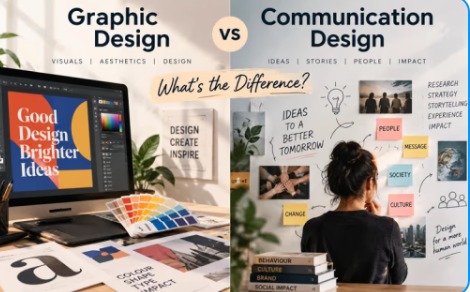
    Graphic Design vs Communication Design: What’s the Difference?

    This guide compares the difference between Graphic Design vs Communication Design, its scope, curriculum, careers, salaries, and future demand

    This guide compares the difference between Graphic Design vs Communication Design, its scope, curriculum, careers, salaries, and future demand

    If you have ever searched for a communication design course in India and found yourself reading about graphic design instead, you are not alone. The two terms are used interchangeably in college brochures, job listings, and design forums, which creates real confusion for students trying to pick a specialisation.

    Here is the short version: Graphic Design is a discipline focused on creating specific visual assets: logos, posters, layouts, and illustrations. Communication Design is a broader field that includes all of that, plus brand strategy, storytelling, information design, interaction design, and integrated communication systems. Think of Graphic Design as a specialisation within the larger Communication Design umbrella.

    The distinction matters because it affects what you study in a B.Des course, what you can do professionally after graduating, and which industries will hire you. A Graphic Designer and a Communication Designer may both use Adobe Illustrator and Figma, but they are solving different problems at different scales.

    This guide compares both disciplines across scope, curriculum, careers, salaries, and future demand, and ends with a practical decision framework to help you choose the right path based on your strengths and goals.

    Graphic Design vs Communication Design: Quick Comparison

    FactorGraphic DesignCommunication Design
    ScopeExecution of visual assetsStrategy, systems, and visual execution
    Primary GoalMake information visually clear and engagingDesign the full communication experience across media and audiences
    Typical OutputsLogos, posters, brochures, typography, packagingBrand identities, design systems, campaigns, digital experiences, information environments
    Core ToolsAdobe Illustrator, Photoshop, InDesignAbove, plus Figma, Miro, motion tools, UX research tools
    Key SkillsTypography, composition, colour, image-makingAbove, plus research, strategy, storytelling, user-centred thinking
    IndustriesAdvertising, publishing, media, FMCG, digital marketingTech, fintech, healthcare, enterprise, FMCG, media, NGOs, government
    Career TitlesGraphic Designer, Art Director, Visual DesignerCommunication Designer, Brand Designer, Design Strategist, Content Designer, Information Designer
    India Salary Range (entry)INR 2.5-4.5 LPAINR 3-6 LPA (broader scope commands slightly higher floor)

    The practical overlap between the two is real. Most jobs in India labelled “Graphic Designer” expect visual execution skills. Most jobs labelled “Communication Designer” or “Brand Designer” expect that plus strategic thinking and multi-channel design ability. Understanding this helps you evaluate job listings as much as it helps you choose a programme.

    What Is Graphic Design?

    Graphic Design is the practice of creating visual communication for a specific purpose: a poster that promotes an event, a logo that identifies a brand, a magazine layout that guides a reader through a long article, a packaging design that communicates product quality before a customer picks it up.

    At its core, Graphic Design is about composition, typography, colour, and image. It is a craft discipline with clear outputs: you begin with a brief, develop concepts, refine them visually, and deliver a finished asset. The process is iterative but bound. The client wants a logo, not a brand strategy.

    Typical deliverables a Graphic Designer produces:

    • Brand logos and identity elements (wordmarks, symbol marks, brand guides)
    • Print materials (brochures, posters, annual reports, packaging)
    • Digital assets (social media graphics, web banners, digital ads)
    • Typography-led compositions for editorial and advertising contexts
    • Infographics, icons, and data visualisation for specific publications

    Industries that hire Graphic Designers in India: Advertising agencies, publishing houses, FMCG companies, media organisations, fashion brands, retail, and increasingly digital marketing teams at startups and large corporates. The global graphic design market is projected to reach USD 83.61 billion by 2034, and 70% of Indian companies raised their marketing spends in 2024, increasing demand for skilled visual execution.

    Graphic Design is an excellent specialisation for students who find satisfaction in the craft of visual making, have a strong eye for composition and typography, and want to work on clearly defined creative briefs. It is one of the most direct paths from a design degree to employed creative work.

    What Is Communication Design?

    Communication Design takes the visual skills of Graphic Design and extends them into strategy, systems, and experience. A Communication Designer does not just ask “how should this look?” They ask “who is the audience, what do they need to understand, what action should this communication prompt, and how does it connect across different channels and touchpoints?”

    A brand identity is a good example of the difference. A Graphic Designer might create the logo. A Communication Designer creates the logo, defines how it behaves across different surfaces (physical, digital, motion), writes the brand voice guidelines, determines how the visual identity scales from a business card to a billboard to a mobile app notification, and ensures the whole system communicates consistently to a defined audience.

    Real-world examples of Communication Design work:

    • A health startup’s complete patient communication system, covering app interface, report design, doctor consultation decks, and public health campaign materials
    • A government initiative’s information design across forms, signage, digital portals, and printed booklets aimed at low-literacy users
    • A D2C brand’s full brand experience, from packaging and social content to website, email design, and in-store displays
    • A museum’s wayfinding system, exhibition graphics, digital touchscreens, and printed interpretation panels

    Why the scope matters in India: India’s expanding startup ecosystem, public sector digital transformation (digital India, government app design), and the growth of D2C and FMCG brands have all created strong demand for designers who can think and work at the communication system level, not just the asset level. Communication Designers are increasingly sought in roles that did not have a clear design title a decade ago: Design Strategist, Content Designer, Brand Experience Manager, Information Designer.

    Curriculum Comparison in a B.Des Programme

    Both Graphic Design and Communication Design specialisations in a B.Design course share a foundation year in Year 1 (drawing, colour, composition, design fundamentals). The differences become visible from Year 2 onwards.

    Subject AreaGraphic Design TrackCommunication Design Track
    TypographyCore, deep focus on typesetting and typefaceCore, extended to typographic systems across media
    BrandingIdentity executionBrand strategy, identity systems, and communication planning
    Publication DesignPrint layouts, magazine designPrint and digital integrated publishing
    Motion GraphicsOften an electiveIncreasingly a core subject (motion is part of communication)
    UI/UX FundamentalsIntroductoryMore developed, sometimes a dedicated module
    Design ThinkingApplied to visual briefsApplied to communication problems at a systems level
    Information DesignRarely coreCore subject (how data and complex information is communicated visually)
    Research MethodsBasicMore developed, includes audience research and communication audits
    Strategy and PlanningRareCore in many programmes

    Communication Design programmes teach more, require more reading and research alongside making, and expect students to articulate the reasoning behind every design decision, not just the execution quality. For students who find the “why” as interesting as the “how”, Communication Design is the stronger curriculum.

    For a closer look at how Communication Design is taught in a B.Des structure, Rishihood University’s overview of Visual Communication Design explains the subject areas and learning approach in detail.

    Career Opportunities and Salary Comparison

    Both disciplines have clear career paths in India, but Communication Design offers a wider range of entry points and a higher salary ceiling at specialist levels.

    Career roles and India salary ranges:

    RoleDisciplineEntry LevelMid-CareerSenior
    Graphic DesignerGraphic DesignINR 2.5-4.5 LPAINR 6-10 LPAINR 10-20 LPA
    Art DirectorGraphic/CommunicationINR 5-8 LPAINR 10-15 LPAINR 15-25 LPA
    Brand DesignerCommunication DesignINR 4-7 LPAINR 8-15 LPAINR 15-25 LPA
    Information DesignerCommunication DesignINR 4-6 LPAINR 8-12 LPAINR 12-20 LPA
    Design StrategistCommunication DesignINR 5-9 LPAINR 10-18 LPAINR 18-30 LPA
    Motion DesignerGraphic/CommunicationINR 3.5-6 LPAINR 7-12 LPAINR 12-20 LPA

    Sources: AmbitionBox 2026 via Curominds, JD Institute salary data, Pearl Academy salary guide

    Freelance and agency opportunities: Graphic Designers working as freelancers in India earn INR 20,000 to INR 50,000 per month at entry level. Experienced freelancers working with international clients can charge USD 25 to USD 100 per hour on platforms like Upwork and Dribbble. Communication Designers with branding or strategy specialisations often command higher project fees because their work scope goes beyond visual asset delivery.

    Key salary influencer across both disciplines: Portfolio quality. A strong portfolio of real-world projects consistently outperforms the degree credential in design hiring decisions. A Communication Designer with documented brand case studies showing research, strategy, and execution earns 20-40% more than a peer with visual assets alone at the same experience level.

    When Rishihood University student Preksha Baid reached the Top 5 at DesignUp 2025 against 730+ global entries at India’s most respected design conference, her concept was evaluated on research depth, communication clarity, and strategic originality, not just visual execution. That is the Communication Design standard in practice.

    Future Scope: AI, Digital Products and Brand Experience

    AI is changing design workflows, but it is changing them in a direction that increases the value of Communication Design skills more than pure execution skills.

    AI tools (Midjourney, Adobe Firefly, Canva AI, Figma AI) can now generate layout options, colour palettes, image variations, and typographic combinations at speed. This is compressing the time required for production-level graphic design tasks. According to Coursera’s analysis of the Bureau of Labor Statistics data, traditional graphic design roles are projected to grow more slowly over the next decade, while the World Economic Forum’s Future of Jobs Report 2025 highlights that creative thinking, originality, and communication remain among the most valuable human skills.

    The designers who are not replaceable are those who can do what AI cannot: understand a brand’s culture, interpret ambiguous briefs, make strategic choices about what a communication should prioritise, and ensure consistency across a complex multi-channel experience. These are Communication Design competencies.

    Emerging roles that are growing specifically because of this shift:

    • Content Designer: Shapes the language and structure of digital products, working at the intersection of UX writing, information architecture, and visual communication
    • Design Systems Designer: Builds and maintains the design components, guidelines, and tokens that keep a product’s communication consistent at scale
    • Brand Experience Designer: Manages how a brand communicates across physical, digital, and experiential touchpoints simultaneously
    • Information Designer: Translates complex data, research, or policy into visual formats that general audiences can understand and act on
    • AI-Augmented Designer: Uses generative tools strategically within a broader design and communication process

    Industry leaders are clear on this direction. Research.com’s analysis of emerging design roles notes that AI-related roles in creative sectors will increase by more than 20% within five years, creating positions that combine design skill with systems thinking and technology literacy. Both of those additional requirements are more aligned with Communication Design training than with traditional Graphic Design.

    The JBM Group Design Roundtable hosted by Rishihood University, which brought together senior design leaders from MakeMyTrip, Blinkit, and Maruti Suzuki, reached a clear consensus on this point: designers who bring mindset and initiative alongside technical skills are the ones companies want. That is exactly what a Communication Design education is structured to develop.

    Which Specialisation Should You Choose?

    Use this decision matrix based on your actual interests and working style, not just the salary table.

    Choose Graphic Design if…Choose Communication Design if…
    You love the craft of making: typography, layout, composition, illustrationYou find the “why” behind a design as interesting as the visual outcome
    You want clear, defined briefs with specific visual outputsYou prefer open-ended problems that require research before designing begins
    You are drawn to advertising, editorial, publishing, or print mediaYou are interested in brands, digital products, public communication, or systems
    You want to build a freelance portfolio of visual assets quicklyYou want to work across a full brand or product as a strategic contributor
    You prefer execution over strategyYou want to lead design conversations with clients and cross-functional teams
    You are comfortable with a narrower but deep skillsetYou prefer a broader skillset that spans research, writing, visual design, and strategy

    The practical reality in India: Most professional design roles do not have a sharp boundary between the two. A Graphic Designer at a growing startup ends up doing brand strategy. A Communication Designer at an agency does a lot of production. The specialisation you choose shapes your starting angle, your portfolio focus, and the kinds of jobs you attract, not a permanent limit on what you can do.

    If you are still undecided, choose Communication Design. The additional breadth it builds in research, strategy, and systems thinking does not close doors for execution-focused roles, but the reverse is less true: a Graphic Design education that does not include design strategy, research, or interaction design can narrow your options earlier than you might want.

    FAQs

    Is Communication Design better than Graphic Design?

    Neither is universally better. Communication Design is broader and tends to open more senior and strategic career paths. Graphic Design is more focused and builds craft skills faster. The right choice depends on whether you are more drawn to visual execution or communication strategy.

    Can a Graphic Designer become a Communication Designer?

    Yes, and many do. The most common path is building graphic design skills in the first few years and then developing brand strategy, research, and digital communication skills through live projects, postgraduate study, or senior roles that expand in scope.

    Which specialisation offers higher salaries?

    Communication Design roles with a strategic component, such as Brand Designer, Design Strategist, or Information Designer, generally command higher salaries at senior levels than pure Graphic Design roles. Both fields pay significantly more with specialisation in motion graphics, UX, or branding than in general visual production.

    Which course has better career opportunities in India?

    Both have strong demand in India’s growing digital economy. Communication Design has broader applications across tech, fintech, healthcare, government, and FMCG sectors. Graphic Design remains essential in advertising, publishing, and brand production.

    Do both fields require coding?

    No. Neither requires coding as a core skill. However, knowing basic HTML/CSS is useful for communication designers working on digital products, and understanding how development constraints affect design decisions makes collaboration easier in both fields.

    Which specialisation is better for branding and digital products?

    Communication Design is the stronger fit for both branding (brand strategy, identity systems, multi-channel communication) and digital products (design systems, content design, UX communication). Graphic Design covers the visual execution within these disciplines but typically does not extend to the strategic layer.

    Build the Right Design Foundation

    Both Graphic Design and Communication Design offer real, growing careers in India’s expanding creative and digital economy. The choice comes down to the kind of problems you want to solve: visual craft or communication systems.

    Rishihood University’s B.Design programme includes Communication Design as a dedicated specialisation within a structured 4-year curriculum, with studio-based learning, industry mentors, live client projects, and 6 months of paid work experience. To understand the curriculum, tools, and career outcomes for each specialisation, download the B.Design brochure or connect with the admissions team directly.

    Your specialisation sets the direction. Your portfolio defines how far you go.

  • India’s Deep Tech Ambition: A Call for Innovation

    India’s Deep Tech Ambition: A Call for Innovation

    Commerce Minister Piyush Goyal set the stage ablaze at Startup Mahakumbh 2025 (April,3rd) challenging India’s startup ecosystem to pivot from consumer-driven ventures like artisanal ice creams to transformative technologies like AI and semiconductor chips.

    The blog reflects on how revolutions often start in overlooked corners, not capitals—like Sridhar Vembu building Zoho in rural Tenkasi, proving world-class innovation can thrive outside cities. His decentralized model of talent and wealth creation mirrors Ajay Piramal’s call for inclusive, last-mile growth. Carrying this spirit forward, Rishihood University has partnered with India’s Capacity Building Commission to reimagine civil service training, is launching its 10th Policy BootCamp, and has received approval to establish an Indic Center for Computational Thinking to bring India’s civilizational lens to AI. From villages to governance to technology, the common thread is recognizing and nurturing India’s hidden talent.

    Sahil Aggarwal https://in.linkedin.com/in/sahilagg92

    What is Deep Tech?

    Understanding deep tech involves recognizing its foundation in original scientific research or complex engineering, requiring years of dedicated research and development to transform groundbreaking discoveries into transformative applications. Unlike incremental innovations, deep tech—encompassing technologies like artificial intelligence, quantum computing, biotechnology, and advanced robotics—drives profound change by addressing critical challenges: agriculture, air pollution, healthcare, and education. For instance, AI-driven crop monitoring can optimize yields for Indian farmers, biotech solutions can curb air pollution through cleaner industrial processes, AI diagnostics can enhance rural healthcare access, and AI-powered edtech platforms can personalize education for millions, meeting India’s unique needs with scalable, impactful solutions.Take OpenAI’s journey as an example. Founded in 2015 with a mission to advance artificial general intelligence, it faced years of rigorous experimentation, evolving from GPT-1 in 2018 to GPT-2 in 2019, and the powerful GPT-3 in 2020. The 2022 launch of ChatGPT, built on these foundations, turned AI into a global phenomenon, impacting everything from education to enterprise solutions. This nearly decade-long effort, backed by billions in funding and collaborations with top researchers, shows deep tech’s power comes from persistence and bold vision.Government funding often ignites these breakthroughs. Agencies like DARPA have fueled transformative innovations likeARPANET, which birthed the internet, and GPS, now critical to global navigation. The National Science Foundation supports cutting-edge AI and biotech research, while India’s DRDO and ISRO drive advancements in quantum tech and space systems, fostering self-reliance. These public investments, often in collaboration with academic institutions and industry, de-risk high-stakes R&D, enabling deep tech to evolve from visionary ideas to solutions that elevate nations and reshape the global landscape.

    Why Deep Tech Startups are important for India?

    Deep tech startups are vital for India’s technological sovereignty and self-reliance (Atmanirbhar Bharat), enabling the nation to assert control over critical technologies and reduce dependence on foreign powers amid geopolitical tensions, as seen in China’s pursuit of independence through innovations like DeepSeek AI despite US restrictions. By driving groundbreaking innovations, such as the discovery of Penicillin that revolutionized medicine, these startups form the backbone of scientific advancements essential for ushering in Industrial Revolution 4.0 and propelling India toward Viksit Bharat—a developed superpower by 2047. Economically, they promise immense growth, with generative AI alone potentially adding $1 trillion to India’s GDP by 2030, as highlighted by former NITI Aayog CEO Amitabh Kant. Strategically, they bolster critical sectors like defense, energy, and healthcare, providing a technological shield against uncertainties.

    Be part of reimagining India’s talent and future. Step into that change with us

    Systemic Barriers and Pathways Forward for India’s Deep Tech Ecosystem

    India’s startup ecosystem, with over 100 unicorns, leans heavily on consumer-driven models, but structural challenges limit deep tech growth, as noted in The Indian Express. To address these, here are key barriers and suggested pathways:Low R&D Funding and Investment: Indian government spends less than 1% of GDP on R&D compared to >3% in the USA, UK, Germany, and Japan, and 2.68% in China; total tech investment from 2014-2024 is $160 billion versus China’s $845 billion. Increase public-private funding and government-backed funds to support high-risk ventures.Long Gestation Periods: Deep tech requires extended timelines beyond typical VC horizons, with a focus on quick returns stifling growth; regulatory hurdles like the now- scrapped Angel Tax exacerbated this. Promote patient capital through incentives and loan guarantees to reduce investor risk.Talent Paradox and Brain Drain: Despite producing lakhs of engineers, few specialize in frontier tech, leading to migration to Silicon Valley (e.g., Aravind Srinivas of Perplexity). Reform education to foster cutting-edge research, advanced labs, and programs to attract and retain global talent.Commercialization Bottlenecks: Challenges in scaling prototypes due to long R&D cycles, weak industry-academia links, and lack of regulatory sandboxes. Strengthen collaborations between IITs/IISc and startups, inspired by US models like DARPA, to facilitate tech transfer.Regulatory and Bureaucratic Hurdles: Complicated IP protection, patent processes, and uncertainties in sectors like genomics and drones delay progress; high import taxes and red tape add friction. Streamline regulations, reduce import duties, and enhance IP ecosystems with faster patent approvals.Global Dominance by USA and China: USA leads via Nvidia, China via 38,000+ generative AI patents (2014-2023) and dominance in 57/64 critical technologies. Encourage international collaborations for joint R&D and global standards participation.Stagnation in Startup Ecosystem: Majority focus on consumer tech rather than deep tech like OpenAI or DeepMind. Shift priorities through targeted policies to nurture high-tech breakthroughs.Lagging Innovation Ecosystem: India ranks 39th in Global Innovation Index 2024 (vs. China’s 11th), with universities trailing in original research. Build robust innovation frameworks via reforms and early-stage programs.These steps can empower India’s deep tech sector to compete globally in AI, cybersecurity, and beyond.

    Thriving Deep Tech Companies in India

    India’s deep tech sector is vibrant, featuring prominent players alongside emerging innovators. Pixxel, a space tech leader, develops hyperspectral imaging satellites for earth observation, securing NASA contracts and significant funding. Agnikul Cosmos, incubated at IIT Madras, pioneers 3D-printed rocket engines and achieved India’s first private orbital launch. Ola Electric, a major EV manufacturer, advances sustainable mobility with indigenous battery tech and gigafactories. Other notables include Chara Technologies, innovating rare-earth-free motors for EVs and defense; Chakr Innovation, reducing emissions with retrofit cleantech devices; ideaForge, leading in UAVs for surveillance and agriculture; Intonation Research Labs, advancing biotech drug discovery; and OrangeWood Labs, offering AI-powered robotic arms for SMEs. These companies, supported by $1.6 billion in 2024 funding (78% YoY growth per Nasscom), highlight India’s rising deep tech capabilities, with ongoing ecosystem enhancements needed for global scaling.

  • Inside the First-Year Student Outcomes of Rishihood University’s CS & DS Program

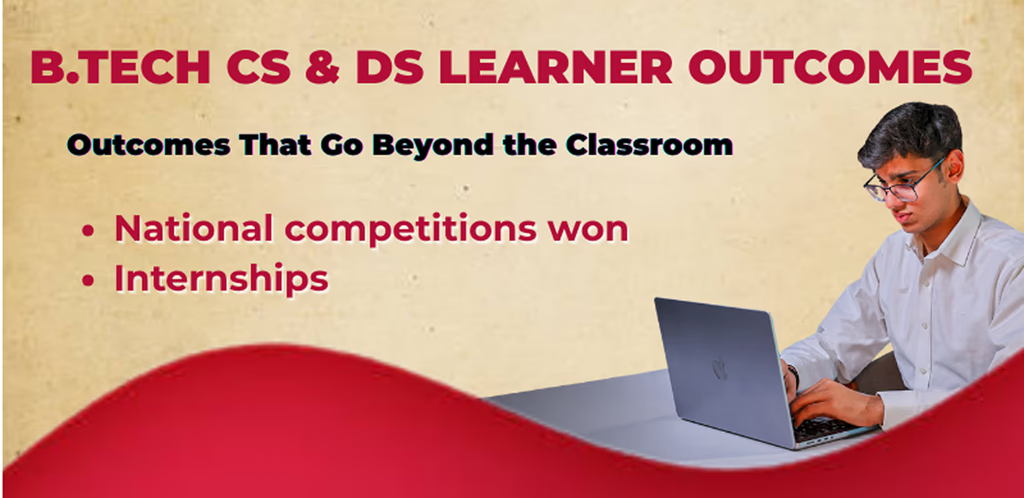
    Inside the First-Year Student Outcomes of Rishihood University’s CS & DS Program

    At Rishihood University, the success of our B.Tech in CS & DS program isn’t measured by grades alone. It shows up in what students build,

  • India’s Deep Tech Ambition: A Call for Innovation

    India’s Deep Tech Ambition: A Call for Innovation

    Commerce Minister Piyush Goyal set the stage ablaze at Startup Mahakumbh 2025 (April,3rd) challenging India’s startup ecosystem to pivot from consumer-driven ventures like artisanal ice creams to transformative technologies like AI and semiconductor chips.

  • 25 Fantastic Career Options in Artificial Intelligence for B.Tech Students

    25 Fantastic Career Options in Artificial Intelligence for B.Tech Students

    The blog lists 25 fantastic career options in artificial intelligence for B.Tech students in India who want to pursue engineering and CS AI.

    Artificial Intelligence (AI) is no longer a futuristic concept—it’s a pervasive transformative force already reshaping industries, economies, and everyday life in general. For students pursuing  B.Tech, particularly those enrolled for Btech in artificial intelligence or Btech CS AI, the career prospects are diverse, high-paying, and future-proof. As faculty in a leading Engineering College in India, it is clear that AI offers not just jobs but a dynamic career landscape where innovation meets application.

    With the global AI market projected to grow at a CAGR of over 35% in the coming years, AI-powered solutions are being adopted across healthcare, finance, manufacturing, education, logistics, and entertainment. This growth translates into significant demand for skilled professionals in multiple AI domains—ranging from machine learning engineering to AI ethics.

    We’ve gathered and curated this guide on the top 25 AI career paths for B.Tech graduates, tailored to both technical specialists and interdisciplinary innovators.

    Top 25 AI Career Options for BTech Students

    Career RoleDescriptionKey SkillsSalary in India (2025)Global Salary (2025)
    1. Machine Learning EngineerDesigns, builds, and deploys ML models for real-world applications.Python, TensorFlow, Scikit-learn, Data Structures.₹9–18 LPA$90K–$150K
    2. Data Scientist (AI)Extracts insights from data and develops predictive models.Statistics, R/Python, Data Visualization, AI Tools.₹8–16 LPA$85K–$140K
    3. AI Research ScientistWorks on cutting-edge AI algorithms and research publications.Deep Learning, NLP, Reinforcement Learning.₹10–22 LPA$100K–$160K
    4. Computer Vision EngineerBuilds AI systems for image and video analysis.OpenCV, PyTorch, CNN Architectures.₹8–15 LPA$80K–$135K
    5. Natural Language Processing (NLP) EngineerDevelops AI systems to process and understand human language.NLP Libraries, Transformers, Linguistics.₹9–17 LPA$85K–$140K
    6. Robotics Engineer (AI)Creates intelligent robots for industries like manufacturing and healthcare.Robotics Frameworks, AI Path Planning.₹7–14 LPA$75K–$130K
    7. AI Product ManagerOversees the development and launch of AI-based products.Product Strategy, AI Understanding, Business Analytics.₹12–20 LPA$95K–$150K
    8. AI Software DeveloperIntegrates AI features into software solutions.Python, APIs, AI Frameworks.₹6–12 LPA$70K–$120K
    9. Deep Learning SpecialistFocuses on advanced neural networks for applications like autonomous vehicles.CNNs, RNNs, GANs.₹10–19 LPA$95K–$145K
    10. AI Solutions ArchitectDesigns AI infrastructure for enterprises.Cloud AI Platforms, System Design.₹15–28 LPA$110K–$170K
    11. AI Ethics OfficerEnsures AI deployment is ethical, unbiased, and compliant.AI Policy, Data Privacy, Governance.₹9–16 LPA$80K–$135K
    12. Business Intelligence (BI) Developer (AI)Uses AI to improve BI reporting and analytics.SQL, Data Warehousing, AI Analytics Tools.₹7–13 LPA$75K–$120K
    13. Autonomous Vehicle EngineerWorks on AI for self-driving technology.Sensor Fusion, Computer Vision, Path Planning.₹11–21 LPA$100K–$160K
    14. AI Hardware EngineerDesigns chips and processors optimized for AI workloads.VLSI, FPGA, Hardware Design.₹10–18 LPA$95K–$145K
    15. AI Trainer (Data Annotation Lead)Supervises data labeling for AI models.Annotation Tools, Data Quality Management.₹5–9 LPA$55K–$95K
    16. AI Cloud EngineerDeploys AI systems on cloud platforms like AWS, Azure, GCP.Cloud AI Services, DevOps.₹9–17 LPA$85K–$140K
    17. Speech Recognition EngineerBuilds AI models for speech-to-text and voice interaction.ASR Systems, Signal Processing.₹8–14 LPA$80K–$130K
    18. AI Operations AnalystMonitors AI systems for performance and compliance.AI Monitoring Tools, Data Analysis.₹6–10 LPA$65K–$105K
    19. AI in Healthcare SpecialistDesigns AI applications for diagnostics, drug discovery.Medical Imaging AI, Bioinformatics.₹10–19 LPA$90K–$150K
    20. AI Game DeveloperCreates AI-powered interactive gaming experiences.Game Engines, AI Pathfinding.₹7–12 LPA$70K–$110K
    21. AI Security SpecialistSecures AI systems against cyber threats.Cybersecurity, AI Threat Modeling.₹9–17 LPA$85K–$140K
    22. Edge AI EngineerWorks on AI models for edge devices (IoT, embedded systems).TinyML, Edge Computing.₹8–14 LPA$80K–$130K
    23. AI Chatbot DeveloperBuilds AI-powered customer support chatbots.Dialogflow, Rasa, NLP.₹6–11 LPA$65K–$110K
    24. AI Curriculum DeveloperDesigns educational content for AI courses.Instructional Design, AI Tools.₹5–9 LPA$55K–$90K
    25. AI Entrepreneur / Startup FounderBuilds and runs AI-driven businesses.AI Business Models, Fundraising.Variable (₹5 L to ₹5 Cr)Variable ($70K to multi-million)

    *Salary brackets have been collected from various resources online, and will most likely vary from city to city, profile, seniority, and other variables.

    1. AI Engineer

    AI Engineers design, implement, and maintain AI systems and models, translating theoretical concepts into real-world applications. Strong programming skills, especially in Python, knowledge of machine learning algorithms, and expertise in frameworks like TensorFlow or PyTorch are essential. AI Engineers often collaborate with data scientists, domain experts, and software teams to deliver scalable solutions.

    2. Machine Learning (ML) Engineer

    ML Engineers focus on creating predictive models that enable systems to learn from data without explicit programming. They handle tasks like feature engineering, algorithm optimization, and deployment of models in production environments. This role is core to most AI jobs in 2025, as organizations increasingly automate decision-making processes.

    3. Data Scientist

    Data Scientists analyze structured and unstructured data to extract meaningful insights. They employ statistical methods, AI techniques, and visualization tools to guide business strategy. A combination of analytical thinking, statistical expertise, and communication skills makes them indispensable in AI-driven organizations.

    4. Data Engineer

    Data Engineers build the pipelines and infrastructure that feed clean, organized data into AI systems. Without robust data engineering, AI projects cannot succeed. This role is critical for ensuring AI models have high-quality inputs for accurate predictions.

    5. Computer Vision Engineer

    Computer Vision Engineers work on systems that can interpret and analyze visual data, enabling applications like facial recognition, medical imaging, autonomous navigation, and augmented reality. This role requires expertise in deep learning architectures like CNNs (Convolutional Neural Networks).

    6. Natural Language Processing (NLP) Engineer

    NLP Engineers develop systems that can understand and generate human language. They work on technologies behind chatbots, speech-to-text systems, and machine translation tools. With advancements in transformer models, NLP expertise is among the most in-demand AI jobs for students entering the market.

    7. Robotics Engineer

    By combining AI with mechanical and electrical engineering, Robotics Engineers build intelligent machines capable of autonomous operation. These range from industrial robots to service robots in healthcare or hospitality.

    8. AI Research Scientist

    Research Scientists push AI boundaries by creating new algorithms, experimenting with architectures, and publishing in peer-reviewed journals. They often work in R&D labs, universities, or leading AI companies. A strong academic background, often with a master’s or PhD, is typical for this role.

    9. AI Product Manager

    AI Product Managers bridge the gap between technical teams and business goals. They oversee the entire lifecycle of AI-powered products, from ideation to launch, ensuring market fit and user satisfaction.

    10. Business Intelligence (BI) Developer

    BI Developers use AI to analyze business data and identify market opportunities. Their work informs strategic planning, making them valuable assets in competitive industries.

    11. Algorithm Developer

    Algorithm Developers design the computational logic that drives AI applications. They work on optimizing efficiency, accuracy, and scalability in AI solutions.

    12. AI Solutions Architect

    AI Solutions Architects design the overarching structure of AI systems, ensuring alignment with organizational needs. They evaluate frameworks, choose deployment environments, and integrate AI seamlessly into workflows.

    13. Cloud Engineer (with AI Focus)

    Cloud Engineers specializing in AI manage cloud-based AI deployments, ensuring models run efficiently and securely on platforms like AWS, Azure, or Google Cloud.

    14. AI/ML Software Developer

    This role focuses on building software products infused with AI capabilities, such as recommendation engines, intelligent search systems, or adaptive user interfaces.

    15. Data Analyst (with AI Specialization)

    Data Analysts interpret datasets to identify patterns, often using AI-driven tools for deeper insights. While less technical than data science, this role remains vital in AI adoption strategies.

    16. AI Consultant

    AI Consultants advise organizations on AI integration, ROI, and transformation strategies. They often work with multiple industries, offering a broad perspective on AI applications.

    17. AI Ethicist

    As AI adoption rises, so do concerns about bias, transparency, and fairness. AI Ethicists ensure AI systems adhere to ethical guidelines and regulatory standards.

    18. Big Data Architect

    Big Data Architects design large-scale data storage and processing systems that support advanced AI models, particularly in industries like e-commerce, healthcare, and finance.

    19. AI Trainer / Data Annotator

    These professionals prepare training datasets by labeling and categorizing data accurately. Although sometimes considered entry-level, it is a crucial step in supervised machine learning projects.

    20. Reinforcement Learning Engineer

    Specialists in reinforcement learning develop systems where AI agents learn through trial and error. Applications include robotics, gaming AI, and autonomous systems.

    21. Speech Recognition Engineer

    Speech Recognition Engineers develop systems that convert spoken language into text and interpret speech patterns. They are central to virtual assistants and transcription services.

    22. Computational Linguist

    This role blends linguistic theory with computational methods to advance natural language processing. It is essential for building multilingual and context-aware AI systems.

    23. Biomedical AI Engineer

    Biomedical AI Engineers apply AI to medical challenges such as diagnostic imaging, drug discovery, and personalized treatment plans. Their work directly impacts healthcare innovation.

    24. UI/UX Designer (with AI Focus)

    UI/UX Designers specializing in AI ensure that AI-powered applications remain intuitive and user-friendly. They design interfaces that effectively communicate complex AI outputs to end users.

    25. AI Hardware Engineer

    AI Hardware Engineers work on specialized processors (like TPUs or GPUs) optimized for AI computations, enabling faster and more energy-efficient model execution.

    Skills and Preparation for AI Careers

    Whether aiming for AI jobs for students in India or international opportunities, core skills remain critical:

    • Proficiency in programming languages (Python, R, Java)
    • Understanding of machine learning algorithms
    • Knowledge of deep learning frameworks (TensorFlow, PyTorch)
    • Statistical and data analysis skills
    • Familiarity with cloud platforms
    • Problem-solving and critical thinking abilities

    Additionally, internships, hackathons, and research projects provide practical exposure, boosting employability. A well-structured AI course career path should combine theoretical knowledge with applied learning.

    AI Career Salaries and Market Outlook for BTech Students

    The demand for AI jobs in 2025 is projected to outpace the supply of qualified graduates, making AI one of the most secure domains for engineers. Students from a reputed Engineering College in Haryana or any top Engineering College in India gain a distinct advantage if they have a curriculum blending AI fundamentals with practical applications.

    In addition to the core BTech CS subjects, AI-focused courses offer specializations like computer vision, NLP, and AI ethics—opening pathways to AI jobs for students in India and abroad.

    In 2025 itself, demand for AI talent has far outstripped supply, creating a favorable job market for years to come. And graduates from an Engineering College in Haryana or any top-tier institute offering the best AI college degrees are sure to benefit professionally.

    For today’s B.Tech students, AI represents a field of study to high-impact, future-ready careers. Choosing the best program like Btech CS or a Btech CS AI specialization allows alignment with industry needs. As faculty, the advice is clear: focus on building a strong foundation, engage with real-world projects, and develop a portfolio that demonstrates both skill and creativity.

    From developing algorithms to managing ethical frameworks, AI careers span an exciting spectrum, offering opportunities to innovate, solve complex problems, and shape the future. For those prepared to commit to continuous learning, the AI industry is not just promising—it’s transformative.