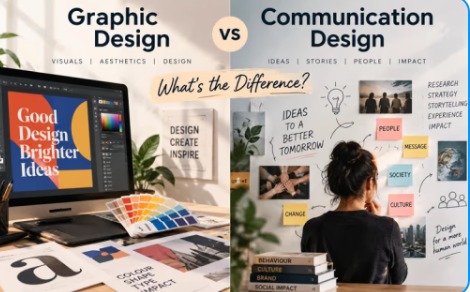
This guide compares the difference between Graphic Design vs Communication Design, its scope, curriculum, careers, salaries, and future demand
This guide compares the difference between Graphic Design vs Communication Design, its scope, curriculum, careers, salaries, and future demand
If you have ever searched for a communication design course in India and found yourself reading about graphic design instead, you are not alone. The two terms are used interchangeably in college brochures, job listings, and design forums, which creates real confusion for students trying to pick a specialisation.
Here is the short version: Graphic Design is a discipline focused on creating specific visual assets: logos, posters, layouts, and illustrations. Communication Design is a broader field that includes all of that, plus brand strategy, storytelling, information design, interaction design, and integrated communication systems. Think of Graphic Design as a specialisation within the larger Communication Design umbrella.
The distinction matters because it affects what you study in a B.Des course, what you can do professionally after graduating, and which industries will hire you. A Graphic Designer and a Communication Designer may both use Adobe Illustrator and Figma, but they are solving different problems at different scales.
This guide compares both disciplines across scope, curriculum, careers, salaries, and future demand, and ends with a practical decision framework to help you choose the right path based on your strengths and goals.
Graphic Design vs Communication Design: Quick Comparison
| Factor | Graphic Design | Communication Design |
| Scope | Execution of visual assets | Strategy, systems, and visual execution |
| Primary Goal | Make information visually clear and engaging | Design the full communication experience across media and audiences |
| Typical Outputs | Logos, posters, brochures, typography, packaging | Brand identities, design systems, campaigns, digital experiences, information environments |
| Core Tools | Adobe Illustrator, Photoshop, InDesign | Above, plus Figma, Miro, motion tools, UX research tools |
| Key Skills | Typography, composition, colour, image-making | Above, plus research, strategy, storytelling, user-centred thinking |
| Industries | Advertising, publishing, media, FMCG, digital marketing | Tech, fintech, healthcare, enterprise, FMCG, media, NGOs, government |
| Career Titles | Graphic Designer, Art Director, Visual Designer | Communication Designer, Brand Designer, Design Strategist, Content Designer, Information Designer |
| India Salary Range (entry) | INR 2.5-4.5 LPA | INR 3-6 LPA (broader scope commands slightly higher floor) |
The practical overlap between the two is real. Most jobs in India labelled “Graphic Designer” expect visual execution skills. Most jobs labelled “Communication Designer” or “Brand Designer” expect that plus strategic thinking and multi-channel design ability. Understanding this helps you evaluate job listings as much as it helps you choose a programme.
What Is Graphic Design?
Graphic Design is the practice of creating visual communication for a specific purpose: a poster that promotes an event, a logo that identifies a brand, a magazine layout that guides a reader through a long article, a packaging design that communicates product quality before a customer picks it up.
At its core, Graphic Design is about composition, typography, colour, and image. It is a craft discipline with clear outputs: you begin with a brief, develop concepts, refine them visually, and deliver a finished asset. The process is iterative but bound. The client wants a logo, not a brand strategy.
Typical deliverables a Graphic Designer produces:
- Brand logos and identity elements (wordmarks, symbol marks, brand guides)
- Print materials (brochures, posters, annual reports, packaging)
- Digital assets (social media graphics, web banners, digital ads)
- Typography-led compositions for editorial and advertising contexts
- Infographics, icons, and data visualisation for specific publications
Industries that hire Graphic Designers in India: Advertising agencies, publishing houses, FMCG companies, media organisations, fashion brands, retail, and increasingly digital marketing teams at startups and large corporates. The global graphic design market is projected to reach USD 83.61 billion by 2034, and 70% of Indian companies raised their marketing spends in 2024, increasing demand for skilled visual execution.
Graphic Design is an excellent specialisation for students who find satisfaction in the craft of visual making, have a strong eye for composition and typography, and want to work on clearly defined creative briefs. It is one of the most direct paths from a design degree to employed creative work.
What Is Communication Design?
Communication Design takes the visual skills of Graphic Design and extends them into strategy, systems, and experience. A Communication Designer does not just ask “how should this look?” They ask “who is the audience, what do they need to understand, what action should this communication prompt, and how does it connect across different channels and touchpoints?”
A brand identity is a good example of the difference. A Graphic Designer might create the logo. A Communication Designer creates the logo, defines how it behaves across different surfaces (physical, digital, motion), writes the brand voice guidelines, determines how the visual identity scales from a business card to a billboard to a mobile app notification, and ensures the whole system communicates consistently to a defined audience.
Real-world examples of Communication Design work:
- A health startup’s complete patient communication system, covering app interface, report design, doctor consultation decks, and public health campaign materials
- A government initiative’s information design across forms, signage, digital portals, and printed booklets aimed at low-literacy users
- A D2C brand’s full brand experience, from packaging and social content to website, email design, and in-store displays
- A museum’s wayfinding system, exhibition graphics, digital touchscreens, and printed interpretation panels
Why the scope matters in India: India’s expanding startup ecosystem, public sector digital transformation (digital India, government app design), and the growth of D2C and FMCG brands have all created strong demand for designers who can think and work at the communication system level, not just the asset level. Communication Designers are increasingly sought in roles that did not have a clear design title a decade ago: Design Strategist, Content Designer, Brand Experience Manager, Information Designer.
Curriculum Comparison in a B.Des Programme
Both Graphic Design and Communication Design specialisations in a B.Design course share a foundation year in Year 1 (drawing, colour, composition, design fundamentals). The differences become visible from Year 2 onwards.
| Subject Area | Graphic Design Track | Communication Design Track |
| Typography | Core, deep focus on typesetting and typeface | Core, extended to typographic systems across media |
| Branding | Identity execution | Brand strategy, identity systems, and communication planning |
| Publication Design | Print layouts, magazine design | Print and digital integrated publishing |
| Motion Graphics | Often an elective | Increasingly a core subject (motion is part of communication) |
| UI/UX Fundamentals | Introductory | More developed, sometimes a dedicated module |
| Design Thinking | Applied to visual briefs | Applied to communication problems at a systems level |
| Information Design | Rarely core | Core subject (how data and complex information is communicated visually) |
| Research Methods | Basic | More developed, includes audience research and communication audits |
| Strategy and Planning | Rare | Core in many programmes |
Communication Design programmes teach more, require more reading and research alongside making, and expect students to articulate the reasoning behind every design decision, not just the execution quality. For students who find the “why” as interesting as the “how”, Communication Design is the stronger curriculum.
For a closer look at how Communication Design is taught in a B.Des structure, Rishihood University’s overview of Visual Communication Design explains the subject areas and learning approach in detail.
Career Opportunities and Salary Comparison
Both disciplines have clear career paths in India, but Communication Design offers a wider range of entry points and a higher salary ceiling at specialist levels.
Career roles and India salary ranges:
| Role | Discipline | Entry Level | Mid-Career | Senior |
| Graphic Designer | Graphic Design | INR 2.5-4.5 LPA | INR 6-10 LPA | INR 10-20 LPA |
| Art Director | Graphic/Communication | INR 5-8 LPA | INR 10-15 LPA | INR 15-25 LPA |
| Brand Designer | Communication Design | INR 4-7 LPA | INR 8-15 LPA | INR 15-25 LPA |
| Information Designer | Communication Design | INR 4-6 LPA | INR 8-12 LPA | INR 12-20 LPA |
| Design Strategist | Communication Design | INR 5-9 LPA | INR 10-18 LPA | INR 18-30 LPA |
| Motion Designer | Graphic/Communication | INR 3.5-6 LPA | INR 7-12 LPA | INR 12-20 LPA |
Sources: AmbitionBox 2026 via Curominds, JD Institute salary data, Pearl Academy salary guide
Freelance and agency opportunities: Graphic Designers working as freelancers in India earn INR 20,000 to INR 50,000 per month at entry level. Experienced freelancers working with international clients can charge USD 25 to USD 100 per hour on platforms like Upwork and Dribbble. Communication Designers with branding or strategy specialisations often command higher project fees because their work scope goes beyond visual asset delivery.
Key salary influencer across both disciplines: Portfolio quality. A strong portfolio of real-world projects consistently outperforms the degree credential in design hiring decisions. A Communication Designer with documented brand case studies showing research, strategy, and execution earns 20-40% more than a peer with visual assets alone at the same experience level.
When Rishihood University student Preksha Baid reached the Top 5 at DesignUp 2025 against 730+ global entries at India’s most respected design conference, her concept was evaluated on research depth, communication clarity, and strategic originality, not just visual execution. That is the Communication Design standard in practice.
Future Scope: AI, Digital Products and Brand Experience
AI is changing design workflows, but it is changing them in a direction that increases the value of Communication Design skills more than pure execution skills.
AI tools (Midjourney, Adobe Firefly, Canva AI, Figma AI) can now generate layout options, colour palettes, image variations, and typographic combinations at speed. This is compressing the time required for production-level graphic design tasks. According to Coursera’s analysis of the Bureau of Labor Statistics data, traditional graphic design roles are projected to grow more slowly over the next decade, while the World Economic Forum’s Future of Jobs Report 2025 highlights that creative thinking, originality, and communication remain among the most valuable human skills.
The designers who are not replaceable are those who can do what AI cannot: understand a brand’s culture, interpret ambiguous briefs, make strategic choices about what a communication should prioritise, and ensure consistency across a complex multi-channel experience. These are Communication Design competencies.
Emerging roles that are growing specifically because of this shift:
- Content Designer: Shapes the language and structure of digital products, working at the intersection of UX writing, information architecture, and visual communication
- Design Systems Designer: Builds and maintains the design components, guidelines, and tokens that keep a product’s communication consistent at scale
- Brand Experience Designer: Manages how a brand communicates across physical, digital, and experiential touchpoints simultaneously
- Information Designer: Translates complex data, research, or policy into visual formats that general audiences can understand and act on
- AI-Augmented Designer: Uses generative tools strategically within a broader design and communication process
Industry leaders are clear on this direction. Research.com’s analysis of emerging design roles notes that AI-related roles in creative sectors will increase by more than 20% within five years, creating positions that combine design skill with systems thinking and technology literacy. Both of those additional requirements are more aligned with Communication Design training than with traditional Graphic Design.
The JBM Group Design Roundtable hosted by Rishihood University, which brought together senior design leaders from MakeMyTrip, Blinkit, and Maruti Suzuki, reached a clear consensus on this point: designers who bring mindset and initiative alongside technical skills are the ones companies want. That is exactly what a Communication Design education is structured to develop.
Which Specialisation Should You Choose?
Use this decision matrix based on your actual interests and working style, not just the salary table.
| Choose Graphic Design if… | Choose Communication Design if… |
| You love the craft of making: typography, layout, composition, illustration | You find the “why” behind a design as interesting as the visual outcome |
| You want clear, defined briefs with specific visual outputs | You prefer open-ended problems that require research before designing begins |
| You are drawn to advertising, editorial, publishing, or print media | You are interested in brands, digital products, public communication, or systems |
| You want to build a freelance portfolio of visual assets quickly | You want to work across a full brand or product as a strategic contributor |
| You prefer execution over strategy | You want to lead design conversations with clients and cross-functional teams |
| You are comfortable with a narrower but deep skillset | You prefer a broader skillset that spans research, writing, visual design, and strategy |
The practical reality in India: Most professional design roles do not have a sharp boundary between the two. A Graphic Designer at a growing startup ends up doing brand strategy. A Communication Designer at an agency does a lot of production. The specialisation you choose shapes your starting angle, your portfolio focus, and the kinds of jobs you attract, not a permanent limit on what you can do.
If you are still undecided, choose Communication Design. The additional breadth it builds in research, strategy, and systems thinking does not close doors for execution-focused roles, but the reverse is less true: a Graphic Design education that does not include design strategy, research, or interaction design can narrow your options earlier than you might want.
FAQs
Is Communication Design better than Graphic Design?
Neither is universally better. Communication Design is broader and tends to open more senior and strategic career paths. Graphic Design is more focused and builds craft skills faster. The right choice depends on whether you are more drawn to visual execution or communication strategy.
Can a Graphic Designer become a Communication Designer?
Yes, and many do. The most common path is building graphic design skills in the first few years and then developing brand strategy, research, and digital communication skills through live projects, postgraduate study, or senior roles that expand in scope.
Which specialisation offers higher salaries?
Communication Design roles with a strategic component, such as Brand Designer, Design Strategist, or Information Designer, generally command higher salaries at senior levels than pure Graphic Design roles. Both fields pay significantly more with specialisation in motion graphics, UX, or branding than in general visual production.
Which course has better career opportunities in India?
Both have strong demand in India’s growing digital economy. Communication Design has broader applications across tech, fintech, healthcare, government, and FMCG sectors. Graphic Design remains essential in advertising, publishing, and brand production.
Do both fields require coding?
No. Neither requires coding as a core skill. However, knowing basic HTML/CSS is useful for communication designers working on digital products, and understanding how development constraints affect design decisions makes collaboration easier in both fields.
Which specialisation is better for branding and digital products?
Communication Design is the stronger fit for both branding (brand strategy, identity systems, multi-channel communication) and digital products (design systems, content design, UX communication). Graphic Design covers the visual execution within these disciplines but typically does not extend to the strategic layer.
Build the Right Design Foundation
Both Graphic Design and Communication Design offer real, growing careers in India’s expanding creative and digital economy. The choice comes down to the kind of problems you want to solve: visual craft or communication systems.
Rishihood University’s B.Design programme includes Communication Design as a dedicated specialisation within a structured 4-year curriculum, with studio-based learning, industry mentors, live client projects, and 6 months of paid work experience. To understand the curriculum, tools, and career outcomes for each specialisation, download the B.Design brochure or connect with the admissions team directly.
Your specialisation sets the direction. Your portfolio defines how far you go.